
The Professional Vibe Coding Handbook

Vibe coding is the new standard, but 'vibes' alone break in production. Learn the professional way to vibe code with specs, context, and architecture.
The Professional Vibe Coding Handbook
Andrej Karpathy, co-founder of OpenAI, recently declared that "The hottest new programming language is English." He coined the term "Vibe Coding" to describe a new reality: writing code by just telling an AI what you want, checking if it works, and moving on.
"I just sort of struggle with the code," Karpathy said. "I write the prompt, run the code, and if it errors, I paste the error back. I just give in to the vibes."
For a weekend project or a flappy bird clone, this is magical. But for professional software engineers, pure "vibes" are dangerous.
When you're building a production app with auth, payments, and rigorous security, giving in to the vibes leads to "The Vibe Gap"—the space between what you imagined and the buggy, hallucinated mess the AI actually wrote.
This handbook is for the Professional Vibe Coder: the developer who wants the speed of AI but the reliability of senior engineering.
The Problem: Why "Generic" Vibe Coding Fails
If you've spent more than an hour with Cursor or Windsurf, you've hit this wall:
- You ask for a feature ("Add a dark mode toggle").
- The AI blissfully rewrites your entire
globals.css, deleting your brand colors. - You spend 30 minutes fixing what the AI broke.
This happens because LLMs are context-hungry but context-starved. They are brilliant juniors who have never seen your codebase before. If you don't give them a map (specs), they will confidently hallucinate their own reality.
Professional Vibe Coding isn't about better prompting. It's about better context.
The 3 Rules of Professional Vibe Coding
To move from "prototyper" to "architect," you need to follow three rules.
Rule 1: Specs Before Prompts
Never start a session with an empty chat window. Before you write a single line of code (or prompts), you must define what you are building.
A generic prompt: "Build a user profile page."
A professional spec: "Build a user profile page using the UserProfile schema in @schema.ts. Use the Card component from @ui-kit. Implement the 'Update Profile' server action with Zod validation."
Context Ark automates this by turning your brain dump into a rigorous Spec Doc (PRD) that you can feed directly to the AI.
Rule 2: You Are the Architect
In the vibe coding era, you are no longer the bricklayer. You are the site manager.
- The AI's job: Write the syntax, handle the boilerplate, remember the regex.
- Your job: Define the data model, enforce security policies, and review the architecture.
If you let the AI make architectural decisions, you will end up with three different state management libraries in one project.
Rule 3: The Context Window Economy
Your AI has a limited "attention span" (context window). If you paste your entire codebase into the chat, it gets confused.
- Bad Vibe:
@codebase(Lazy, leads to shallow understanding) - Pro Vibe:
@Spec-Auth.md+@Spec-DesignSystem.md(Targeted, high-signal context)
The Professional Stack
To vibe code effectively, you need the right tools.
- The Engine: Cursor (or Windsurf). These editors integrate the AI directly into your file system.
- The Brain: Claude 3.5 Sonnet. Currently the SOTA (State of the Art) model for coding tasks.
- The Blueprint: Context Ark. The missing layer that generates the specs your AI needs to stop hallucinating.
The Workflow: From Brain Dump to Production
Here is the exact loop used by senior AI engineers.
Step 1: The Brain Dump
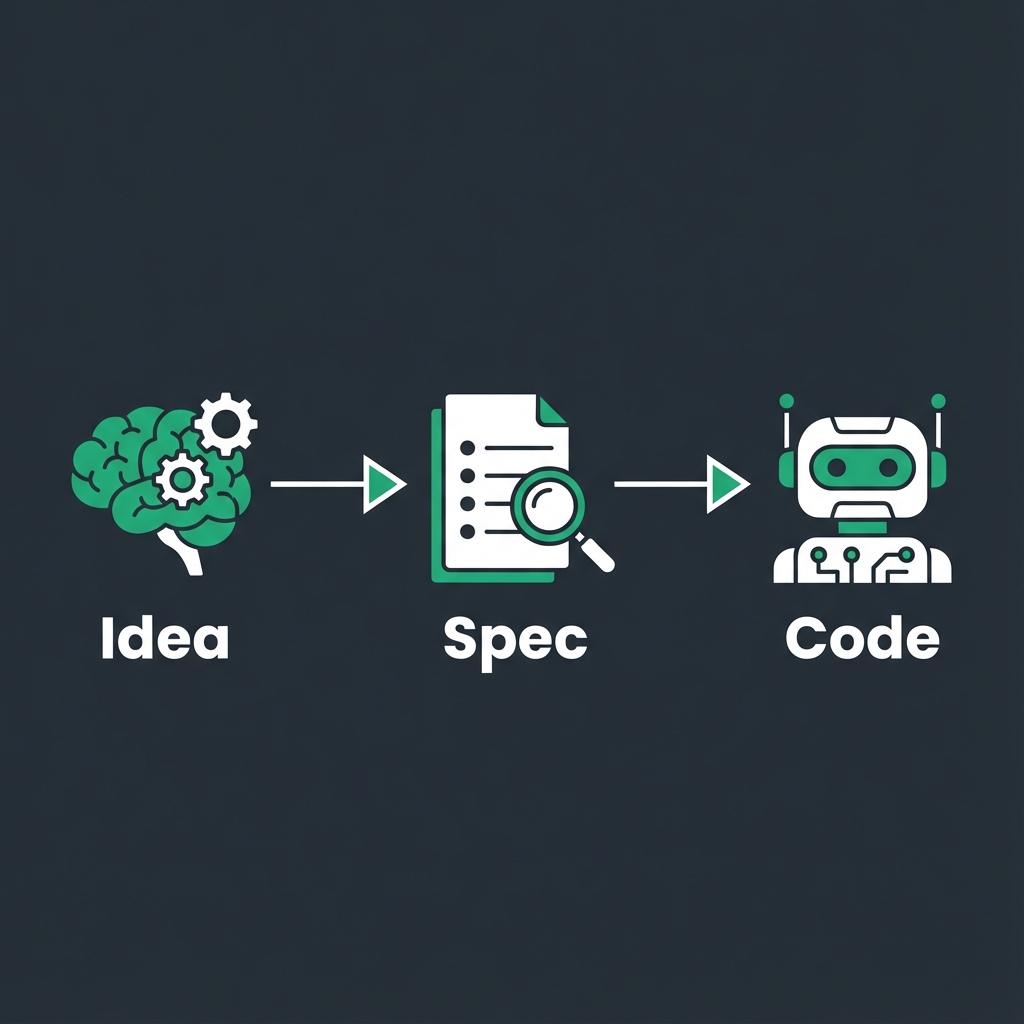
Don't write tickets. Just dump your thoughts.
"I need a dashboard that shows user retention. It should have a chart, a table, and a CSV export. Only admins can see it."
Step 2: Generate the Spec (The "Anti-Hallucination" Layer)
Use a tool like Context Ark's PRD Generator to turn that brain dump into a technical spec. The spec will define:
- Non-goals: (e.g., "Do not implement real-time updates yet").
- Data Model: (e.g., "Use the
analytics_eventstable"). - Edge Cases: (e.g., "What if there is no data?").
Step 3: The "Vibe" Prompt
Now, you paste the spec into Cursor.
"Cursor, implement the 'User Retention Dashboard' feature as defined in
@PRD-Dashboard.md. Follow the patterns in@Design-System.md."
Step 4: The Review
Because the AI had a spec, it likely got 90% of the code right. Your job is now just to verify the logic and security.
Conclusion: Don't Just Vibe. Architect.
Vibe coding is the future. It allows one developer to do the work of a team. But without discipline, it allows one developer to create the technical debt of a team.
Adopting a Spec-Driven approach is the difference between a prototype that dies on your laptop and a product that ships to thousands of users.
Ready to upgrade your vibes? Check your Spec Readiness Score to see if you're giving your AI enough context to succeed.
Context Ark Team
Writing about AI, documentation, and developer tools
Is your spec ready for AI?
Vibe coding fails when context is missing. Get a readiness score and find out what you're forgetting.