The Vibe Coding Problem: Why 'Just Prompt It' Doesn't Scale (And What Does)
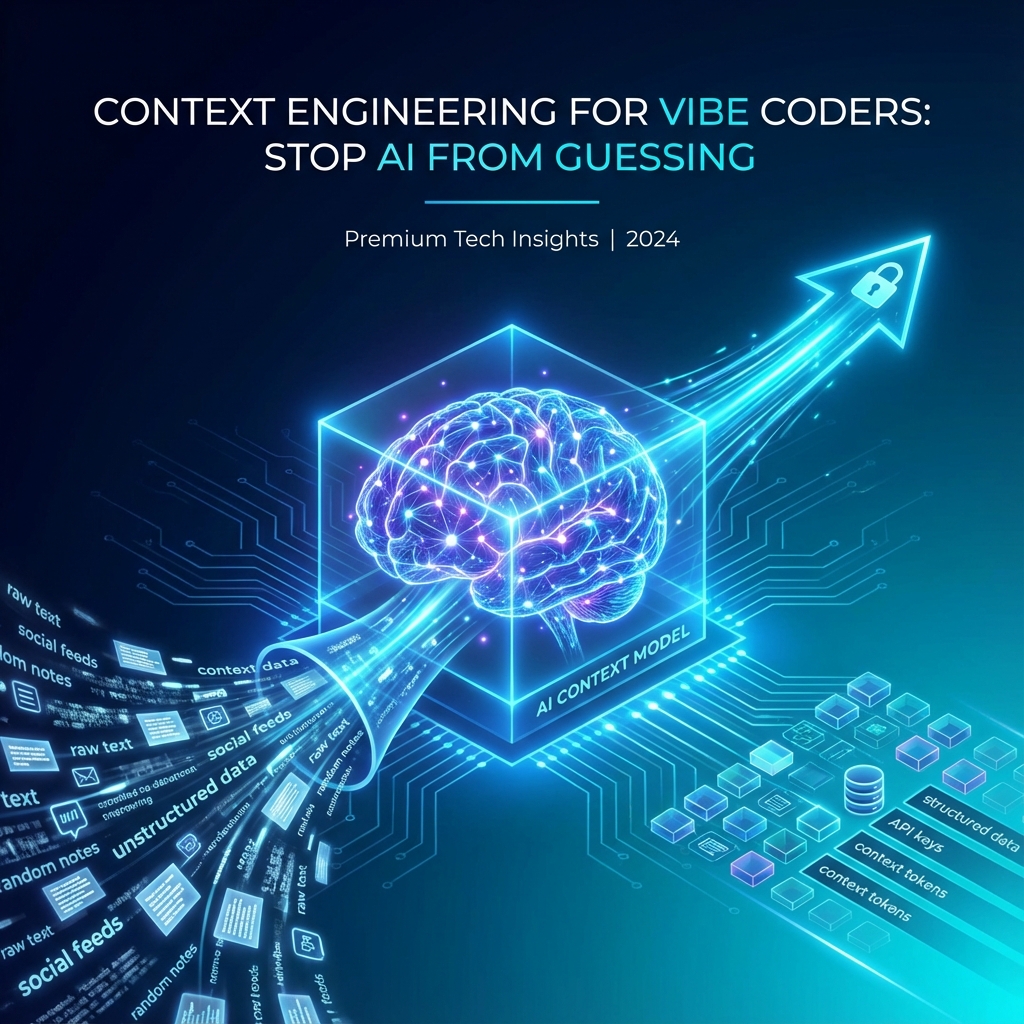
Vibe coding works for demos but breaks at scale. This guide explains why casual AI prompting fails as projects grow—and the spec-driven alternative that actually scales.
TL;DR: "Vibe coding"—casually prompting AI without specs—works for demos and prototypes. It fails catastrophically as projects grow because AI lacks persistent context. The fix: spec-driven development.
Table of Contents
- What is Vibe Coding?
- Why Vibe Coding Is So Appealing
- The Scaling Problem
- Real Failure Patterns
- The Math of Vibe Coding
- When Vibe Coding Works
- When Vibe Coding Breaks
- The Spec-Driven Alternative
- Transitioning from Vibe to Spec
- FAQs
What is Vibe Coding?
Vibe coding (popularized by Google AI Studio's "vibe mode" and developer culture) is the practice of:
- Having an idea
- Prompting an AI tool with minimal context
- Accepting and pasting output
- Fixing errors as they appear
- Repeating until it works
The Vibe Coding Workflow
Idea → Prompt → Paste → Error → Fix → Prompt → Paste...
Characteristics:
- No formal specifications
- Minimal upfront planning
- High prompt-to-code ratio
- "Just make it work" mentality
- Context provided per-prompt, not persistently
Where the Term Comes From
Andrej Karpathy (Tesla AI, OpenAI) and others have described this approach as "vibing with the model"—a creative, exploratory style of development where you:
"Give in to the vibes, embrace exponentials, and forget that the code even exists."
Google's AI Studio explicitly promotes "vibe coding" as a feature for rapid prototyping.
Why Vibe Coding Is So Appealing
The Demo Effect
Vibe coding produces impressive demos fast:
- "I built a landing page in 5 minutes!"
- "I created a full CRUD app in an hour!"
- "Look at this dashboard I made by just describing it!"
These results are real and exciting. They sell the vision of AI-first development.
The Friction Reduction
Traditional development has friction:
- Requirements gathering
- Architecture design
- Documentation
- Code review processes
Vibe coding eliminates all of this. Just prompt and go.
The Learning Curve
Vibe coding has nearly zero learning curve:
- No new methodologies to learn
- No templates to follow
- No documentation standards
- Just describe what you want
The Dopamine Loop
Vibe coding creates a powerful feedback loop:
- Prompt
- See immediate result
- Feel productive
- Repeat
This loop is addictive—and misleading about actual productivity.
The Scaling Problem
What Changes as Projects Grow
| Factor | Small Project | Large Project |
|---|---|---|
| Files | 5-20 | 100+ |
| Components | 3-10 | 50+ |
| API endpoints | 2-5 | 30+ |
| Database tables | 1-5 | 20+ |
| Team members | 1 | 2-10+ |
| Dependencies | Few | Many |
| Context needed | Can hold in head | Impossible to remember |
The Context Window Limit
AI tools have finite context windows:
- GPT-4: 128K tokens
- Claude: 200K tokens
- Even with large windows, your project exceeds them
As your codebase grows, AI can see less of it proportionally, leading to more hallucinations.
The Compounding Problem
Each vibe-coded feature adds:
- Inconsistent patterns
- Undocumented decisions
- Conflicting conventions
- Hidden dependencies
These compound. By feature #20, the codebase is a minefield of inconsistencies that even YOU can't navigate—let alone an AI.
Real Failure Patterns
Pattern 1: The Contradiction Cascade
Week 1: Vibe code a user auth system using one pattern Week 2: Vibe code more features, AI uses different auth pattern Week 3: Features conflict, auth breaks in production Week 4: Debugging nightmare—which pattern is "correct"?
Pattern 2: The API Zoo
// File 1: Vibe coded in January
await fetch('/api/users');

// File 2: Vibe coded in February
await apiClient.get('/api/user');

// File 3: Vibe coded in March
await fetchApi('users', 'GET');

// File 4: Vibe coded in April
await usersService.getAll();
Result: Four different patterns for the same operation. Maintenance nightmare.
Pattern 3: The Schema Drift
Database over time:
user_id,userId,id_user,user(all referencing users)created_at,createdAt,created,date_createdis_active,active,status,enabled
Each vibe coding session used whatever column names AI suggested. Now your schema is chaos.
Pattern 4: The Undocumented Feature
You vibe coded a complex feature. It works (mostly). Three months later:
- You need to modify it
- You can't remember how it works
- There's no documentation
- The original prompts are lost
- You're debugging your own mystery code
The Math of Vibe Coding
Short-Term Economics
Vibe Coding Time = Prompt + Paste + Quick Debug
                 = 5-30 minutes per feature
This looks efficient.
Long-Term Economics
Real Cost = (Initial Vibe Time)
          + (Inconsistency Debug Time × Feature Count)
          + (Pattern Conflict Resolution)
          + (Refactoring Cost)
          + (Onboarding New Team Members)
          + (Production Bug Fixing)
The Break-Even Point
| Project Size | Vibe Coding Total Time | Spec-Driven Total Time |
|---|---|---|
| 5 features | 2 hours | 4 hours |
| 10 features | 6 hours | 6 hours |
| 20 features | 20 hours | 10 hours |
| 50 features | 100+ hours | 20 hours |
Break-even: Around 10 features, spec-driven development becomes faster.
The Hidden Tax
Every vibe-coded line carries a "confusion tax":
- Future-you will struggle to understand it
- AI will hallucinate against it
- Team members will duplicate it incorrectly
- Tests will miss edge cases
This tax compounds silently until the project becomes unmaintainable.
When Vibe Coding Works
Legitimate Use Cases
-
Proof of concepts
- Not intended for production
- Will be rewritten if successful
- Speed is the only priority
-
One-off scripts
- Single-use utilities
- No maintenance expected
- No team involvement
-
Learning and exploration
- Trying new technologies
- Understanding concepts
- Not building real products
-
Hackathons and demos
- 24-48 hour time limit
- Judged on concept, not code quality
- Throwaway after event
-
Very small projects
- 3-5 features maximum
- Single developer
- No long-term maintenance
The Rule of Thumb
Vibe code if:
- You'll throw it away within a week
- You're the only one who'll ever touch it
- It has fewer than 5 features
- It doesn't handle real user data
When Vibe Coding Breaks
Red Flags
- You've started saying "it's somewhere in the codebase"
- Different files handle similar things differently
- You're afraid to refactor because "it might break something"
- New features take longer than early features
- You spend more time debugging than building
- Onboarding takes days instead of hours
- Production bugs are increasing, not decreasing
The Point of No Return
Once a vibe-coded project reaches "critical mass" of inconsistency, options narrow:
| Option | Cost | Outcome |
|---|---|---|
| Continue vibe coding | Very high | Eventual failure |
| Gradual refactoring | High | Slow recovery |
| Spec and rewrite | Medium | Clean restart |
| Abandon project | Write-off | Sometimes correct |
The Spec-Driven Alternative
What Spec-Driven Means
Instead of prompt-per-feature, create persistent specifications that:
- Define your project's structure
- Document your conventions
- Specify your APIs and schemas
- Guide AI with consistent context
The Spec-Driven Workflow
Brain Dump → Specs Generated → AI Uses Specs → Consistent Code
Key Documents
| Document | Purpose | Prevents |
|---|---|---|
| PRD | Define scope | Feature creep |
| API Spec | Define endpoints | API inconsistency |
| Database Schema | Define columns | Schema drift |
| Architecture | Define patterns | Pattern mixing |
| Conventions | Define standards | Style chaos |
Why This Scales
Week 1: Create specs (1-2 hours with Context Ark) Week 2-52: AI references specs for every feature Result: Consistent patterns across entire codebase
The upfront investment pays dividends on every subsequent feature.
Transitioning from Vibe to Spec
Step 1: Freeze New Vibe Coding
Stop adding new vibe-coded features. This stops the bleeding.
Step 2: Document What Exists
Create specs that describe your CURRENT state:
- What endpoints exist?
- What tables exist?
- What patterns are used?
- What conventions have emerged (even if inconsistent)?
Step 3: Establish Standards
From the chaos, pick winners:
- "We'll use THIS API pattern going forward"
- "We'll use THIS naming convention from now on"
- Document these as the new standard.
Step 4: Spec Future Work
All new features get speced before coding:
- PRD for requirements
- API spec for endpoints
- Schema changes for database
Step 5: Gradual Refactoring
Over time, update old vibe-coded sections to match new specs. Don't try to fix everything at once.
Timeline Expectation
| Phase | Duration |
|---|---|
| Document existing state | 1-2 days |
| Establish standards | 1 day |
| Set up spec workflow | 1 day |
| First spec-driven features | Immediate |
| Full codebase consistency | 3-6 months |
FAQs
Isn't spec writing slow?
With Context Ark: 30-60 minutes for comprehensive specs Without Context Ark: 2-4 hours
Either is faster than the debugging time saved.
What about Google's Vibe Code promotion?
Google AI Studio's vibe coding is designed for:
- Prototyping
- Learning
- Demos
- Small experiments
It's not promoted as a production development methodology.
Can I vibe code the MVP then add specs?
You can, but you'll likely need to refactor the MVP significantly. If you plan to iterate on the product, start with specs.
How do specs work with AI tools?
- Cursor: Add specs to
.cursor/rules/ - Cline: Reference in
.clinerules - Context Ark: Export ready-to-use packs
What if I'm a solo developer?
Specs help solo developers too:
- Future-you is a team member
- Specs prevent self-inflicted confusion
- AI tools perform better with specs
Conclusion
Vibe coding is appealing because it's fast and fun in the short term. It fails because:
- AI lacks persistent context
- Inconsistencies compound
- The codebase becomes unmaintainable
- Debugging eclipses development
Spec-driven development invests 1-2 hours upfront to:
- Define persistent context
- Ensure consistency
- Scale sustainably
- Let AI actually help
The choice isn't "vibe OR structure." It's "invest now OR pay later."
Resources
Blog Posts
Templates
Free Tools
- PRD Generator — Generate a PRD with non-goals and acceptance criteria
- Spec Readiness Score — Check your context coverage before building
- Scope Lock Wizard — Split MVP from Post-MVP features
- Cursor Rules Generator — Create .cursorrules for your tech stack
Scale your AI coding. Generate specs with Context Ark →
Last updated: January 2026
Context Ark Team
Writing about AI, documentation, and developer tools
Is your spec ready for AI?
Vibe coding fails when context is missing. Get a readiness score and find out what you're forgetting.